
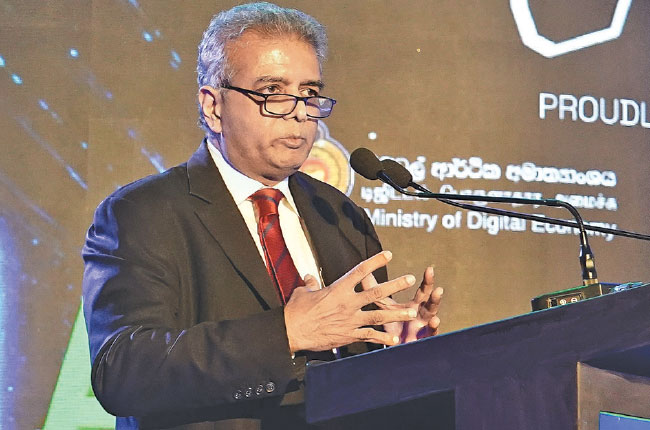
Sri Lanka needs to establish a minimum level of sovereign artificial intelligence (AI) capability to ensure that technologies increasingly driving the economy, public services and national development remain under adequate national control, Chief Advisor to the President of Sri Lanka on Digital Economy Dr. Hans Wijesuriya said.
Delivering the keynote address at AI Amplified Sri Lanka – AI Week 2026 in Colombo, Dr. Wijesuriya said in Colombo yesterday, AI should be embedded into the country’s digital public infrastructure (DPI), while Sri Lanka must clearly determine what it should build, buy, rent, share and protect.
He said AI sovereignty should not be measured simply by the physical location of servers or Graphics Processing Units, but by the degree of control a country exercises over its AI infrastructure, data and intelligence.
“If AI is at the epicentre of our economy, our human development programme and our future culture, and someone else controls it, if someone else can switch it off, then I think we are doing major injustice to the future generation,” he said.
Dr. Wijesuriya stressed that data classification alone would no longer be sufficient, as AI systems generate intelligence from data that could itself have different levels of sensitivity.
Sri Lanka therefore needs to determine what intelligence should remain strictly within the country, what can be shared under safeguards and what can be made publicly available, he said.
He also warned that the drive to build globally competitive AI applications could unintentionally deepen domestic inequality unless inclusion remains a central consideration. For instance, an English-language AI tutoring application could primarily benefit those who already have access to technology and English-language skills, potentially widening the education divide.
“There’s always a trade-off between building external competitiveness and internal inclusion,” Dr. Wijesuriya said.
He proposed an agentic layer within the country’s digital public infrastructure, supported by a national agent control plane capable of establishing AI-agent identities and defining what individual agents can and cannot do. Such mechanisms would form part of a broader framework of AI guardrails and governance at the national level.
Dr. Wijesuriya said Sri Lanka was also advancing initiatives covering AI research, an AI Centre of Excellence and an “AI for All” programme to broaden access to AI knowledge.
These initiatives are expected to be incorporated into AI Blueprint 2.0, which is to be released for public consultation and designed to make the country’s AI strategy future-ready towards 2030.
He said Sri Lanka’s relatively small market also creates challenges in negotiating with global technology giants, making shared digital platforms and sector-specific AI capabilities, including small language models, increasingly important.
Source : Daily News