
Dharma Sri Abeyratne
India has taken steps to provide research, innovation and technical assistance for the advancement of Sri Lanka’s digitalization project.
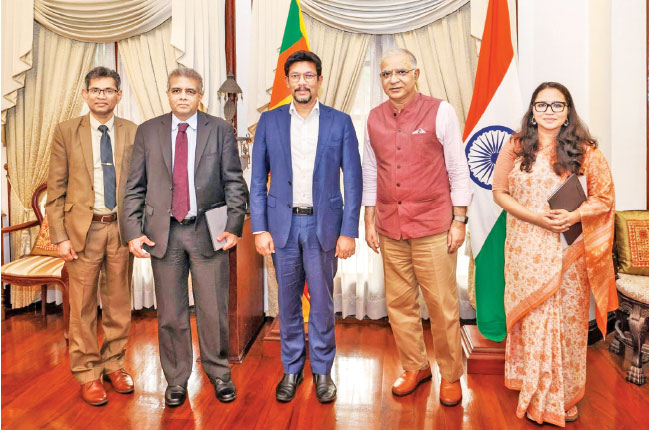
Under this, India will support Sri Lanka-India digital cooperation and Sri Lanka’s journey towards becoming a regional technology hub. With the aim of further strengthening digital cooperation between Sri Lanka and India, a delegation including the Deputy Minister of Digital Economy, Eranga Weeraratne, engaged in a special discussion with the Indian High Commissioner, Santhosh Jha, at the India House.
Dr. Hans Wijeyasuriya, Senior Advisor to the President on Digital Economy and Chairman of the Information and Communication Technology Agency (ICTA), and Waruna Sri Dhanapala, Secretary, Ministry of Digital Economy, also participated in the meeting. In light of the Artificial Intelligence (AI) Summit held in New Delhi, the importance of adopting a techno-legal approach with strong governance structures in line with global standards was highlighted by both sides.
Special attention was paid to the development of data centers and artificial intelligence infrastructure, and the High Commissioner further pointed out that there is a high interest of Indian investors in the proposed AI zone to be established in the country. The development of digital public infrastructure (DPI) for infrastructure planning using satellite data, disaster management and especially for the optimization of the activities of the fishing community, taking the example of India’s ‘PM Gati Shakti’ programme, was also discussed at length. Also, both sides agreed to build a structural cooperation by activating the Joint Working Group (JWG) under the existing Memorandum of Understanding between the two countries and protecting intellectual property rights.
The meeting also discussed the possibility of linking Sri Lankan SMEs with programmes of leading institutions like NASSCOM in India and expediting the Economic and Technical Cooperation Agreement (ETCA) between the two countries. It was proposed to seek Indian assistance in establishing ‘Tinkering Labs’ and AI learning centres to popularise robotics and coding across all provinces of the island as a step towards digitalisation of the education sector. Another notable point discussed was the possibility of Sri Lanka joining the ‘Bharat 6G Mission’ programme for cutting-edge telecommunications research.
One of the most important outcomes of the meeting was the decision to establish Research, Development (R&D) and Commercialisation Partnerships between Sri Lankan universities and leading institutions like IIT Madras in India.
This will provide an opportunity to jointly develop research conducted in Sri Lanka, strengthen technology transfer mechanisms and elevate the country’s engineering capabilities to international standards. Through this sustainable partnership based on quality, security and innovation, Sri Lanka will be further strengthened in its efforts to establish itself as a competitive digital hub in the region.
Source: Daily News