
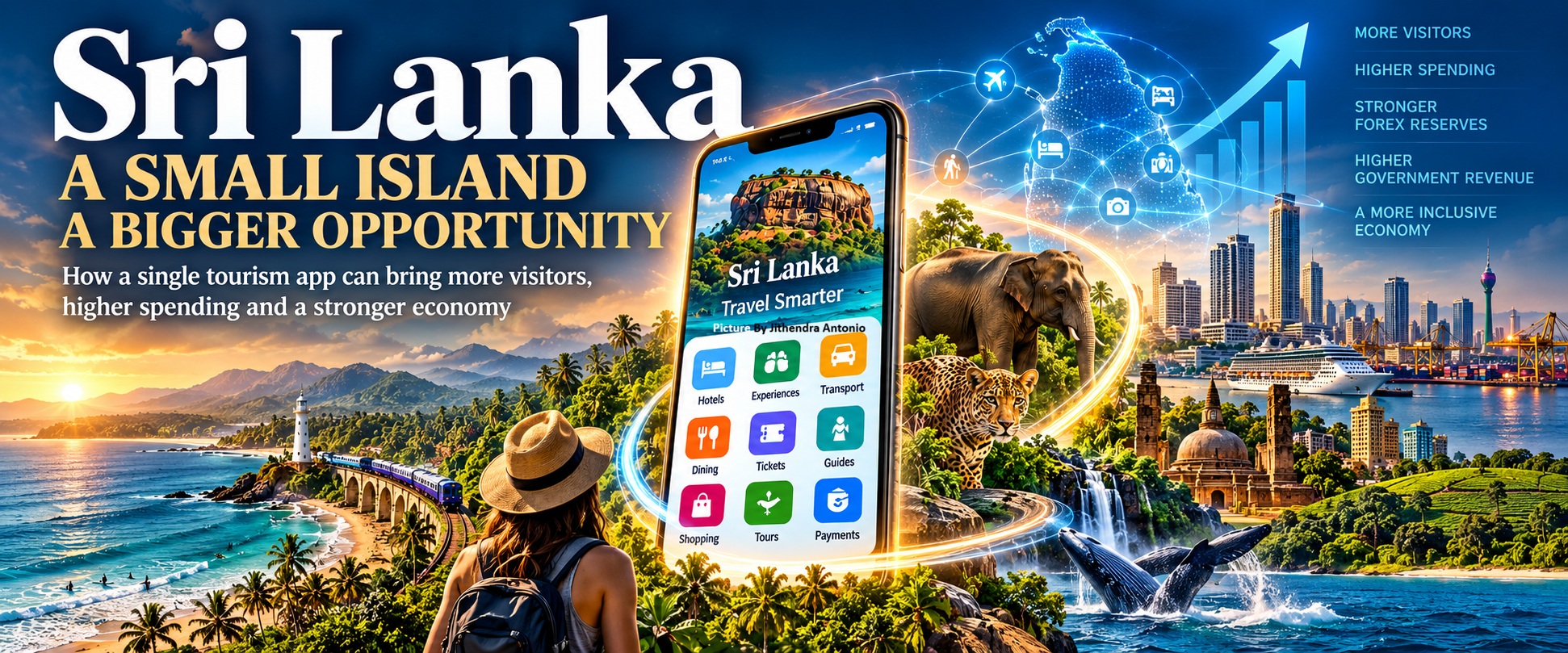
A US$300 Million Tourism Super App? How Sri Lanka Could Connect Foreign Exchange, Telecom, National Parks, Government Resorts and Every Major Tourist Experience into One National Revenue Engine
By Jithendra Antonio
The next great opportunity in Sri Lankan tourism may not be another hotel, another airport terminal or another advertising campaign. It may be the creation of a government-backed digital platform that connects the tourist, the bank, the mobile network, the national park, the heritage site, the government bungalow, the restaurant and the local entrepreneur—turning a fragmented visitor economy into a connected commercial ecosystem.
Sri Lanka has become remarkably good at counting tourists.
It knows how many visitors arrive each month, which countries they come from, how arrivals rise during the winter travel season and how quickly the numbers can collapse when a terrorist attack, pandemic or economic crisis intervenes. The country has spent years rebuilding the tourism industry after the end of the civil war on 18 May 2009, recovering from the Easter Sunday attacks, surviving the pandemic and navigating the economic collapse that exposed the country’s dependence on foreign exchange.
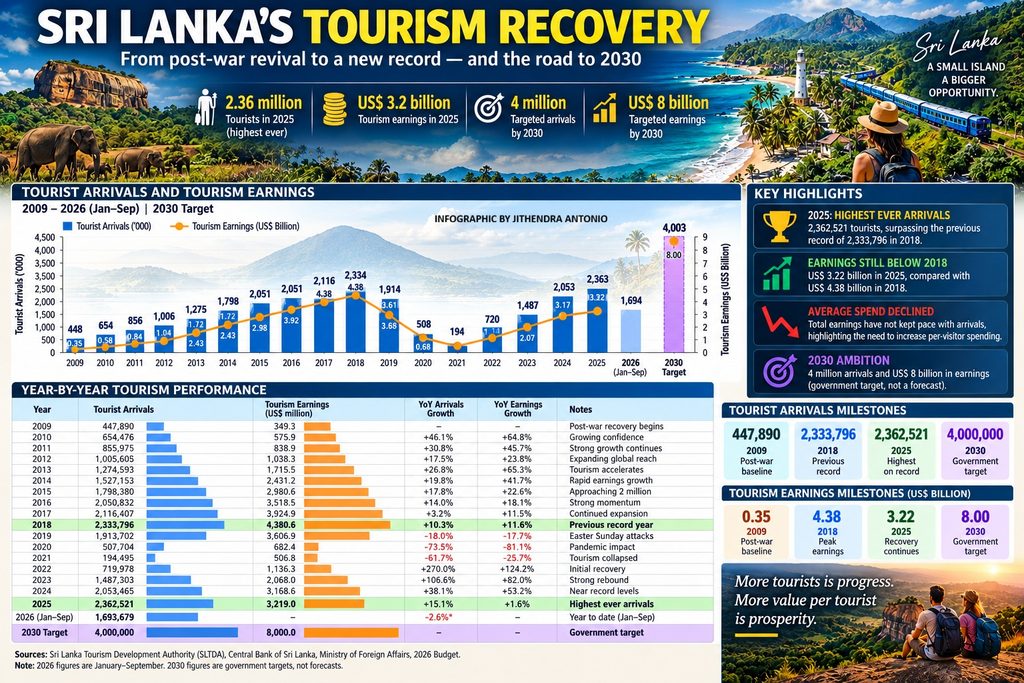
The numbers tell a story of recovery. Sri Lanka received 447,890 tourists in 2009. By 2018, arrivals had climbed to 2,333,796. The pandemic reduced the annual figure to 194,495 in 2021. Recovery followed, and in 2025 the country recorded 2,362,521 arrivals, generating approximately US$3.2 billion in tourism revenue.
But the next phase of tourism development demands a different question.
What if Sri Lanka could earn revenue not only from the tourist’s holiday, but from the financial, digital, transport, communications, accommodation and entertainment services surrounding that holiday?
What if, immediately after landing, a visitor could access a Tourism Account, select a local mobile SIM or eSIM, obtain a reloadable debit card, book a safari, purchase a ticket to Sigiriya, reserve a government-owned bungalow, arrange an airport transfer, buy travel insurance, book a whale-watching excursion, pay a restaurant bill and discover lesser-known attractions—all through one trusted application?
What if the same platform connected those tourists to thousands of Sri Lankan businesses while giving participating government institutions a modern commercial distribution channel?
And what if the government could earn revenue from the financial infrastructure, the telecommunications distribution, the booking marketplace, the ticketing systems and the digital services—without having to own every hotel, operate every tour or employ every driver?
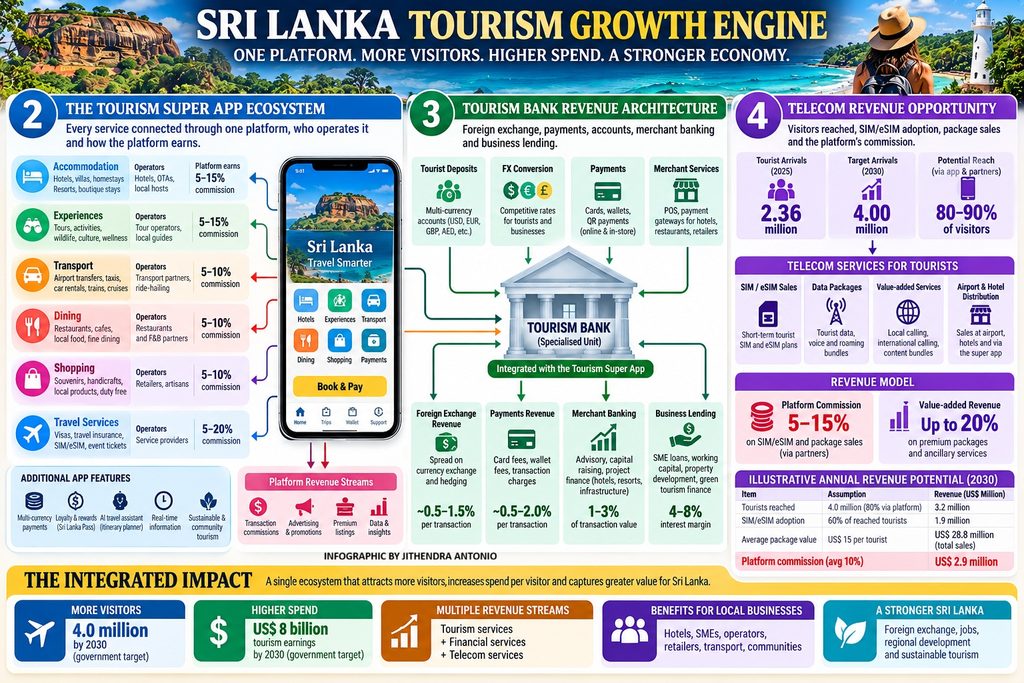
This is the proposition behind a Sri Lanka Tourism Super App: a commercially integrated platform built around a Tourism Bank, a visitor-selected telecommunications connection, digital payments, public attractions, government leisure properties and a nationwide marketplace of private tourism businesses.
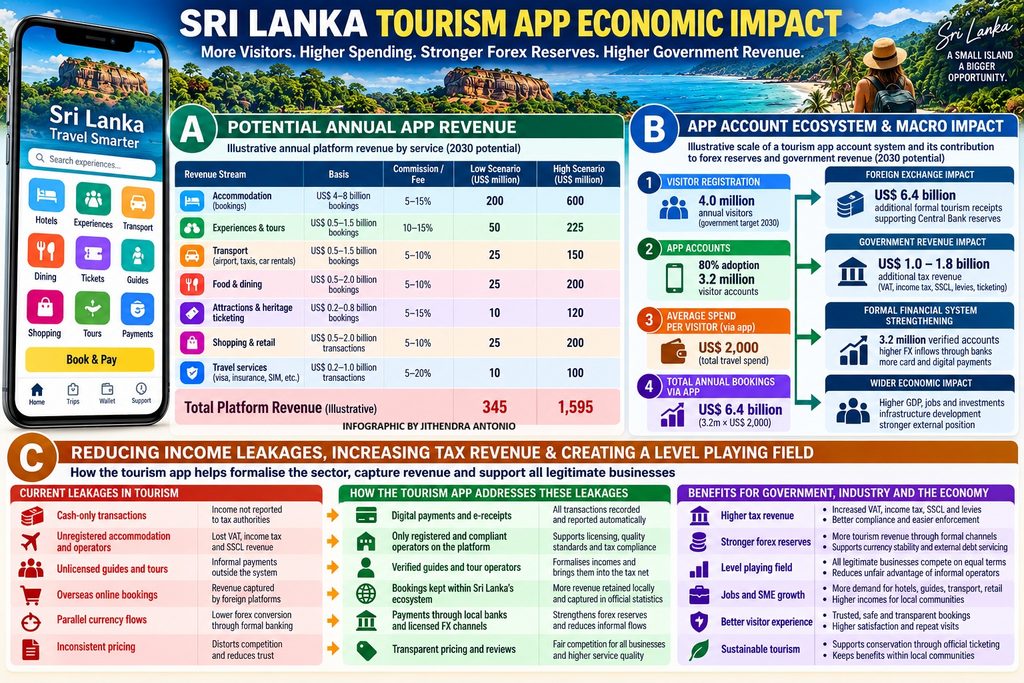
The financial ceiling could be substantial. Under an aggressive but explicitly illustrative model aligned with a four-million-arrival tourism economy, a mature platform might generate approximately US$200 million to US$350 million in annual gross revenue across its connected businesses.
That is a high-end scenario, not a forecast, an official government estimate or a guaranteed profit. Achieving it would require a large share of tourist spending to move through the platform, commercially viable banking margins, substantial merchant participation, effective telecom partnerships, reliable technology and competent management.
But the scale of the opportunity deserves a more serious examination than another discussion about selling SIM cards at an airport.
The prize is to build a connected commercial gateway into Sri Lanka’s entire visitor economy.
The real business begins when the aircraft lands
Consider a tourist arriving at Bandaranaike International Airport.
The visitor needs an internet connection. The visitor may need rupees, transport, a hotel, a route to the south coast, a ticket to a heritage site, a wildlife safari or a reservation at a restaurant. The visitor may need to understand how to pay, where to go, which services are trustworthy and how to obtain assistance when something goes wrong.
At present, those needs can be scattered across airline websites, telecom counters, bank counters, international booking platforms, hotel applications, taxi services, attraction ticket offices, travel agents and individual operators.
Every business sees a portion of the customer. No single platform necessarily captures the complete commercial relationship.
That fragmentation creates an opportunity.
A Tourism Super App would offer a single digital entry point. A visitor could download the application before departure or use a simple onboarding process at the airport. The tourist would choose a preferred telecom operator and package, open or activate an eligible Tourism Account, select a payment method and begin planning the journey.
The application could then recommend services according to the visitor’s interests. A family travelling with children might see wildlife experiences, family-friendly accommodation and transport options. A visitor interested in archaeology might be offered heritage tickets, museum visits and a multi-day Cultural Triangle itinerary. A traveller heading to Arugam Bay might see accommodation, surf schools, transport and nearby experiences. A visitor interested in wildlife could compare safari operators, select a park entry slot where available, reserve a jeep and pay through the same system.
Each transaction would create a potential revenue opportunity. More importantly, the app would connect the tourist to local businesses that might otherwise be difficult to discover or book.
The platform would not need to own every underlying service. It would need to make those services easier to find, trust, reserve and pay for.
That distinction is central to the business model. The largest digital marketplaces are often valuable not because they own every asset being sold, but because they control the customer relationship, the distribution channel and the transaction infrastructure.
Sri Lanka could apply that principle to tourism.
The Tourism Bank: the financial engine beneath the app
The first pillar would be a specialised Tourism Bank or a dedicated tourism-banking operation established through a legally and commercially appropriate structure.
At the airport, a visitor could be offered a Tourism Account with a proposed minimum opening balance of US$100. The account could be linked to a physical debit card, a virtual card and the super app. Visitors could add funds through approved international transfers, eligible cards or other authorised funding methods.
The account would allow the visitor to make payments at participating Sri Lankan merchants, subject to the relevant payment-network and foreign-exchange arrangements.
The bank could earn revenue from several distinct activities.
Foreign-exchange services. A visitor who converts foreign currency into rupees may generate an exchange margin for the bank. That margin would depend on the actual conversion, funding route, competition, wholesale costs and applicable regulations.
Payment services. The bank could earn eligible income from card issuance, payment processing, merchant acquiring or network-related arrangements. The exact economics would depend on contracts and the division of revenue among the bank, payment network and other providers.
Account services. Optional premium features, replacement cards, selected account services and other transparently priced products could contribute revenue. A basic account should remain simple and affordable if widespread adoption is the objective.
Merchant banking. Participating hotels, restaurants, tour operators and retailers could use the bank for settlements, working capital, business accounts and other financial services.
Business lending. Subject to prudent underwriting, the bank could lend to tourism enterprises that demonstrate credible cash flow, including guesthouses, transport operators, restaurants, craft producers and local suppliers.
The objective would be to create a banking business that benefits from the commercial activity generated by tourism, rather than relying exclusively on fees charged to arriving visitors.
The distinction is important. If the product is built around excessive fees or an unattractive exchange rate, tourists will seek alternatives. If it provides reliable payments, transparent conversion, broad acceptance and useful services, the account becomes part of the travel experience rather than an obstacle to it.
The foreign-exchange question
The bank’s role in national foreign-exchange management must also be described accurately.
Customer deposits are liabilities owed to customers. They cannot simply be treated as government revenue. A bank’s foreign-currency holdings do not automatically become the Central Bank’s official reserves. Any transfer of foreign currency to the Central Bank or another authorised counterparty must occur under applicable rules and through legitimate transactions.
The bank could still help formalise tourist payments, provide more reliable information about spending and potentially increase the share of visitor funds entering the domestic financial system through authorised channels.
The economic benefit would depend on the additional foreign exchange captured compared with what would have entered the formal system anyway.
That is a measurable commercial question—and one that should be answered through a properly designed pilot rather than inflated claims.
The telecom line: turning the tourist’s first internet connection into a business relationship
The second pillar would be a telecom distribution platform integrated into the app.
A tourist arriving in Sri Lanka typically wants mobile connectivity quickly. The super app could allow the visitor to choose from participating licensed mobile operators, compare prepaid packages and activate a physical SIM or eSIM where supported.
The tourist might choose a short-stay package for a three-day visit, a larger data bundle for a two-week holiday or a package suited to remote work and longer stays. The choice would remain with the customer.
The super app would not need to become a telecommunications operator itself. It could act as a distribution, activation and customer-service channel under commercial agreements with licensed operators.
The platform could earn a commission for each activated line or package, a revenue share on eligible top-ups, and potentially a fee for other services agreed with the telecom partner.
The telecom operator would retain its own share of the revenue and remain responsible for the regulated telecommunications service. The super app would earn distribution income for bringing in the customer and simplifying activation.
At the high end, the opportunity becomes interesting because the service is not limited to the first SIM sale.
A visitor who buys a seven-day package might purchase another data bundle, extend the stay or return to Sri Lanka months later. The app could provide top-ups, roaming information, travel alerts and destination services. A repeat visitor might keep the app installed and use it for future trips.
The platform could also offer local businesses a digital communications channel, subject to user consent and privacy protections.
The essential point is that the telecom connection gives the app a practical reason to be installed and used from the beginning of the journey. Once a visitor is connected, the application can offer accommodation, attractions, transport, ticketing and payments.
The mobile line is not the whole business. It is a customer-acquisition channel into the wider ecosystem.
What could telecom distribution earn?
Consider an illustrative scenario in which 70 per cent of four million annual visitors purchase a participating SIM or eSIM package through the platform. That would represent 2.8 million package sales.
If the average package sale were US$20, the total value of packages sold would be US$56 million.
But that US$56 million would be telecom sales volume, not the super app’s revenue. Most of the revenue would belong to the telecom operator. If the platform received an illustrative 10–20 per cent distribution commission, its revenue would be approximately US$5.6 million to US$11.2 million.
Actual results would depend on package prices, the share of visitors who buy through the app, negotiated commission rates, taxes, wholesale costs and customer usage.
The platform should not assume that every tourist will purchase a new SIM. Some will roam on their home networks, use an existing eSIM, rely on Wi-Fi or already have a suitable local connection. The commercial opportunity lies in offering a convenient choice, not in pretending every visitor is a guaranteed sale.
Sri Lanka already has a regulated telecommunications market, and the Telecommunications Regulatory Commission publishes sector statistics. The proposed model should therefore be developed with licensed operators and within the existing regulatory framework, rather than as an attempt to bypass it.
The public attraction network: national parks become bookable digital products
The third pillar could connect national parks and other public attractions to the platform.
Sri Lanka has 28 national parks, according to the Department of Wildlife Conservation. The country’s wildlife offering ranges from iconic parks such as Yala and Wilpattu to Udawalawe, Horton Plains and other protected areas with different landscapes, ecosystems and visitor experiences.
These places are not merely scenic backdrops. They are destinations with ticketing, transport, guide services, vehicle requirements, visitor management, conservation obligations and opportunities for local businesses.
The super app could offer a single discovery and booking interface for eligible experiences, including:
- National park entry and authorised permits.
- Safari vehicle bookings with licensed or approved operators.
- Whale-watching and marine experiences where legally authorised.
- Guided nature walks and interpretation services.
- Museum and heritage tickets.
- Approved boat services and other designated visitor experiences.
- Transport links between accommodation and attractions.
- Nearby food, accommodation and local experiences.
A tourist could compare available experiences, understand what is included, see the total price, pay securely and receive a booking confirmation. Where permits or entry slots are controlled by the relevant authority, the app would need to integrate with the official allocation and reservation system rather than promise availability it cannot guarantee.
This is particularly important for wildlife. A commercial platform must not encourage overcrowding, unsafe vehicle practices, wildlife disturbance or excessive visitation to fragile habitats. Conservation limits must come before the app’s sales targets.
The commercial proposition is that a better booking system can improve the visitor experience while making payments, capacity and revenue easier to track.
The existing revenue base is already substantial
Sri Lanka does not have to invent demand for national parks.
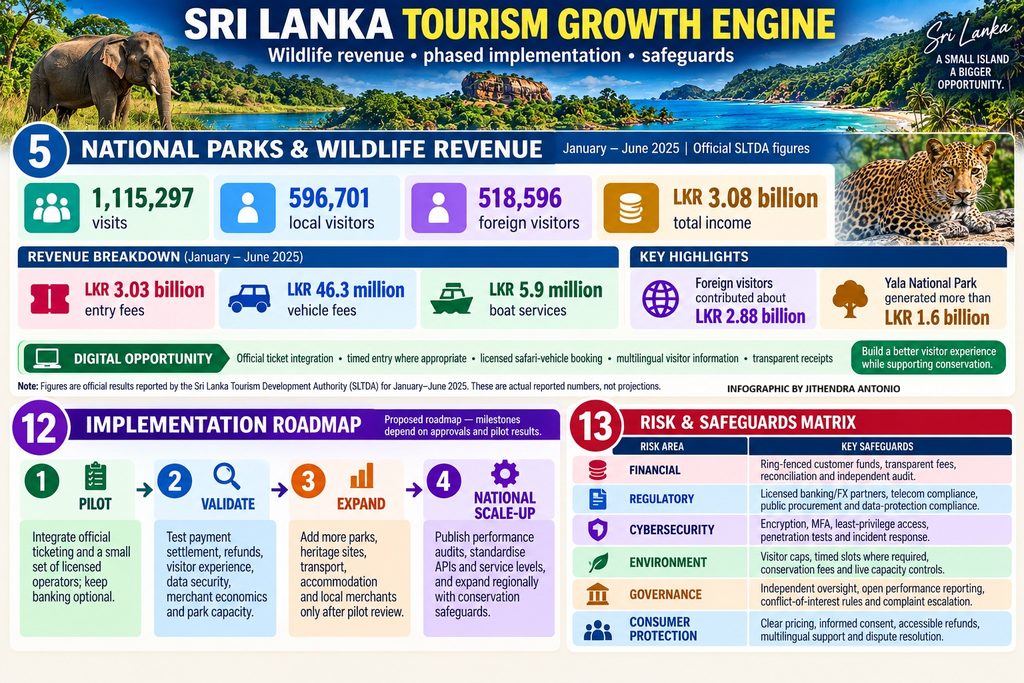
During January–June 2025, national parks and wildlife attractions recorded 1,115,297 visitors and generated approximately LKR 3.08 billion. The official figures cited by the SLTDA show that foreign visitors accounted for about LKR 2.88 billion of the total. Yala alone generated more than LKR 1.6 billion in that period.
That is an important starting point. It demonstrates that the wildlife sector already generates significant public revenue, with a strong contribution from foreign visitors.
The super app’s opportunity would not be to claim that all this revenue is new. Much of it is already being collected. The opportunity is to make the existing system more convenient, expand legitimate bookings where capacity permits, improve add-on sales, connect visitors with local operators and earn a transparent fee for the booking service.
For example, if the app processed US$30 million in eligible public-attraction and associated ticket sales annually, and the platform received an average service commission of 5 per cent under approved agreements, its revenue would be US$1.5 million. At US$60 million in sales, the same commission would produce US$3 million.
These are illustrative scenarios, not forecasts of the current value of all Sri Lankan attraction tickets. Any fee structure would have to be negotiated with the relevant authorities and justified by demonstrable service improvements. Where public law requires a ticket fee to go directly to a government fund, the platform should collect and remit it correctly rather than retain public money as if it were its own income.
The value of the app is not only the commission. It is also the ability to distribute demand across more destinations, help visitors plan their journeys and make the purchasing process easier.
The overlooked government property portfolio
The fourth pillar may be one of the most intriguing.
Sri Lanka’s 2026 Budget identified more than 900 underutilised government-owned tourist bungalows and resorts for development into income-generating units with private-sector support.
This presents a potentially valuable opportunity, but the number must be interpreted carefully. It refers to identified properties, not necessarily 900 fully operational hotels, and not 900 identical accommodation units. Their condition, room count, location, legal status, operating costs, renovation requirements and commercial viability may vary considerably.
A Tourism Super App could nevertheless provide a common digital marketplace for those properties that are legally available and commercially ready.
Imagine a traveller searching for accommodation in the hill country. The app could show available government bungalows, privately operated guesthouses and participating hotels side by side, with transparent prices, photographs, amenities, cancellation terms and location information.
A visitor heading to a wildlife destination might discover a government property that is underused because it lacks effective marketing or an easy booking channel. A family could reserve a property through the app, pay in advance and arrange transport or nearby experiences.
The platform could help participating property operators manage availability, payments, customer communication, reviews and pricing. Government owners could see occupancy, revenue and maintenance needs more clearly.
The app should not automatically become the owner or manager of every property. Different properties may require different arrangements: direct government operation, private management contracts, leases, concessions or public-private partnerships. The platform can provide the booking and distribution layer while ownership and operating responsibilities remain with the appropriate parties.
An illustrative accommodation model
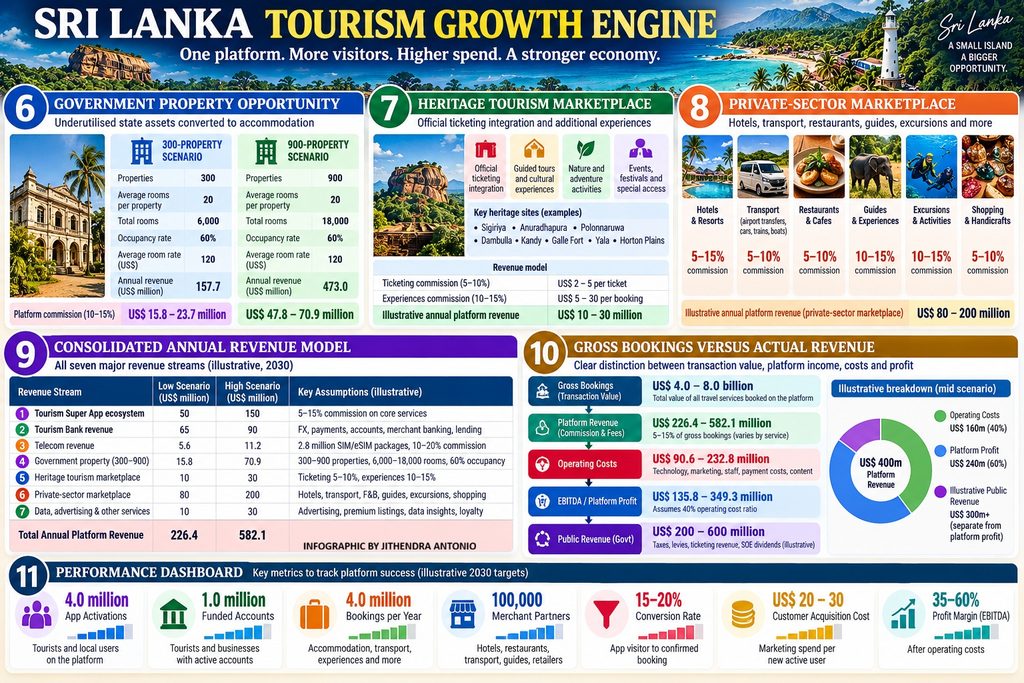
Suppose 300 of the identified government properties eventually become commercially bookable through a coordinated platform. This is an illustrative subset, not a claim that 300 properties are currently ready.
Assume each property has an average of five sellable rooms, giving 1,500 rooms in total. At an average nightly room rate of US$60 and 45 per cent annual occupancy, the properties would generate approximately US$14.8 million in annual room revenue.
The calculation is:
1,500 rooms × 365 nights × 45% occupancy × US$60 = approximately US$14.8 million.
If the platform earned a 10 per cent booking commission under the relevant operating agreements, its revenue would be approximately US$1.48 million.
If the participating portfolio expanded to 900 properties, with the same hypothetical room count per property and the same price and occupancy assumptions, the implied room revenue would be approximately US$44.3 million, and a 10 per cent booking commission would be approximately US$4.43 million.
That second scenario assumes every one of the 900 properties can be made commercially available with five sellable rooms. It is a scale illustration, not an estimate of the actual portfolio. A proper feasibility study must establish the real room inventory, repair costs, staffing, seasonal demand and the investment needed to bring each property to market.
The broader opportunity is still compelling: Sri Lanka could turn underused public tourism assets into bookable products and give those products a common digital distribution channel.
The heritage economy: from a ticket counter to a complete experience
The fifth pillar is cultural and heritage tourism.
Sri Lanka’s ancient cities, archaeological sites, museums and religious heritage attract visitors who may be willing to plan multi-day itineraries and pay for guided experiences, transport, accommodation and interpretation.
The Central Cultural Fund already provides online booking for designated heritage sites, including Sigiriya, Anuradhapura, Polonnaruwa and Dambulla. It also offers a Cultural Triangle ticket arrangement for multiple sites.
The super app should therefore connect to existing official services where possible, not create a parallel ticketing system that confuses tourists or undermines public institutions.
A visitor could buy a heritage ticket, reserve a guide, arrange transport and book nearby accommodation through one interface. The platform might suggest a two-day route through the Cultural Triangle, taking into account opening hours, travel times, ticket validity and the visitor’s interests.
For a family, the app could offer a guided archaeological experience and nearby dining. For a history enthusiast, it could connect the visitor to specialist guides, museums and approved cultural programmes. For a traveller staying longer, it could combine heritage destinations with wildlife, wellness and coastal experiences.
The revenue opportunities include booking commissions on eligible private services, agreed digital-service fees, premium itinerary products and commercial partnerships. Public ticket revenue must still be accounted for according to the rules governing each institution.
This is where the app could help Sri Lanka increase spending per visitor. It would not simply sell entry to a site. It would make it easier for visitors to discover and purchase the surrounding experiences.
The marketplace: hotels, restaurants, guides, drivers and local producers
A tourism platform becomes much more valuable when it is not restricted to government-owned assets.
The sixth pillar would be an open marketplace for participating private businesses, including:
- Hotels, guesthouses, villas and registered homestays.
- Licensed tour operators and local guides.
- Airport transfers, private drivers and authorised transport providers.
- Restaurants, cafés and culinary experiences.
- Surf schools, diving operators and other activity providers.
- Wellness services and approved spa operators.
- Local craft producers and cultural experiences.
- Boat trips, excursions and other legally authorised activities.
The marketplace would earn commissions on eligible bookings, with the rates varying by product category and service agreement. A hotel booking might carry a different commission from a guided excursion. A small local operator might require a lower fee to remain competitive. High-volume partners might negotiate different commercial terms.
The objective should be to increase the number of businesses able to reach visitors, not to extract the highest possible commission from every transaction.
A platform that charges excessive fees will push suppliers away or encourage them to move customers off-platform. A platform that delivers real bookings, secure payment, clear cancellation procedures and customer support can justify a reasonable commission.
The marketplace would also need reliable quality controls. It should distinguish verified operators from unverified listings, make cancellation terms clear, provide a mechanism for complaints and ensure that businesses offering regulated services hold the necessary approvals.
This is a critical part of the economic argument. A super app should not become a digital gatekeeper that extracts revenue while small businesses carry all the operating risk. Its long-term value depends on whether local enterprises earn more through it than they would without it.
The maximum-revenue scenario: what could the complete platform earn?
The following is a high-end illustrative model for a mature platform operating in a tourism economy approaching four million annual arrivals and US$8 billion in tourism earnings. That ambition was included in Sri Lanka’s 2026 Budget.
The model assumes substantial adoption, broad merchant participation, a functioning telecom distribution network, commercially viable banking operations and a large marketplace of private and public tourism products.
It is deliberately an aggressive scenario. It should not be mistaken for a base case.
Rounded, the upper scenario points to a possible US$200 million to US$350 million annual gross-revenue opportunity.
This is the maximum-level commercial case for the connected platform, not a statement that the government could immediately earn US$350 million. It is also not a forecast of profit, dividends or foreign-exchange reserves.
First, the US$90 million to US$145 million banking line is an aggressive scale assumption derived from the earlier illustrative banking model and scaled toward a four-million-arrival economy. It must be validated against actual foreign-exchange volumes, fee schedules, regulatory requirements, funding costs and operating expenses.
Second, the US$96 million to US$144 million marketplace line assumes US$1.2 billion in annual booking value for the specified private-sector categories and an effective commission of 8–12 per cent. That booking value would need to be demonstrated through real bookings, not inferred automatically from total national tourism earnings.
Third, the public-ticketing and government-accommodation lines cover separate service categories from the private marketplace line. They must be structured to avoid counting the same booking value twice. Ancillary referral income should only be recognised where it arises from a distinct, contracted service.
Fourth, the telecom figure is the platform’s estimated commission—not the total money paid by tourists to telecom operators.
Finally, these are gross revenue lines before the full cost of staff, technology, payment networks, fraud losses, customer support, marketing, compliance, maintenance, insurance, taxes, financing and other operating expenses. The actual net profit could be materially lower.
The illustrations in this are useful because it shows the size of the opportunity if multiple commercial engines work together. It is not a substitute for a bank feasibility study, a marketplace business plan or independently audited financial projections.
How the app could scale from today’s market to a four-million-visitor economy
The most important commercial variable is not simply the number of arrivals. It is the percentage of visitor activity captured by the platform.
A tourist who downloads the app but never makes a transaction creates little direct revenue. A tourist who activates a SIM, loads a Tourism Account, books a hotel, purchases a park ticket and reserves two excursions may generate several legitimate revenue opportunities.
The platform should therefore track a set of measurable operating indicators:
- Share of arrivals that activate the app.
- Share of activated users who fund a Tourism Account.
- Average amount loaded and average amount spent.
- Share of eligible visitor spending processed through the platform.
- Number of active merchants and their repeat booking rates.
- Average booking value and effective commission rate.
- Telecom activation rate and top-up frequency.
- Public-attraction bookings processed digitally.
- Repeat use by returning visitors.
- Customer acquisition cost compared with revenue per active user.
- Refund, fraud and complaint rates.
- Net contribution after payment-network and operating costs.
These metrics would allow management to determine whether the platform is creating a sustainable business or merely processing large volumes at a loss.
The same approach should be used to distinguish three concepts that are often confused in tourism discussions.
Gross booking value is the total value of goods and services sold through the platform.
Platform revenue is the commission, fee or other income that the platform is entitled to retain.
Economic benefit to Sri Lanka is the wider value created for local suppliers, workers, public services and the foreign-exchange system.
They are related, but they are not the same. A platform could process US$1 billion in bookings and earn US$100 million in commissions, while the remaining amount goes to accommodation providers, transport operators, attractions and other suppliers. The US$1 billion cannot be reported as platform revenue.
Likewise, a dollar passing through a Tourism Account does not automatically become an additional dollar of official reserves.
Financial discipline is essential if the project is to win the confidence of investors, regulators and the public.
A new commercial channel for the state—without turning the state into a monopoly
The strongest case for the platform is that government does not need to own every business to benefit from the ecosystem.
A public tourism institution could make an eligible national park or heritage ticket available through the app. A government property could gain access to a wider booking market. A licensed telecom operator could sell more packages. A private hotel could obtain new customers. A local guide could receive bookings from visitors who would otherwise never discover the service. The Tourism Bank could provide payments and business accounts.
Each participant would earn according to its role.
This is a more flexible model than attempting to create a state monopoly over every part of the tourist’s journey. It also allows the platform to build partnerships with existing businesses rather than displace them.
The government could establish the public-interest objectives, data standards, consumer safeguards and access rules while allowing the platform to operate under professional commercial management. Depending on the chosen legal structure, the platform could be a government-owned company, a public-private venture or a regulated digital-services operation with clear contractual relationships.
Any structure would need to address procurement, conflicts of interest, data protection, cybersecurity, financial regulation and the fair treatment of private competitors.
The app should not receive privileged access to public assets without transparent agreements. It should not use public funds to subsidise commercial partners without disclosure. It should not sell customer data or use personal financial information for unrelated purposes.
A credible national platform needs trust as much as it needs technology.
What could be done with the revenue?
If the platform eventually produces sustained profits, there is a case for a transparent distribution framework.
A portion could be retained to maintain the technology, expand the merchant network and strengthen customer service. Another portion could support investment in the platform’s commercial operations. Dividends or other lawful distributions could flow to the relevant owners under the applicable corporate and public-finance rules.
Separately, government could decide through the proper budgetary and legal process how to fund conservation, heritage preservation, tourism infrastructure or small-business development. Those public expenditures should not be confused with customer deposits or with the gross value of transactions processed by the app.
The broader economic case is that a stronger tourism ecosystem can create more opportunities for local suppliers and improve the quality of the visitor experience.
If more hotels buy from local farmers, more restaurants source from domestic producers and more tour operators employ local guides, a greater share of visitor spending can circulate within Sri Lanka. The app could help those businesses reach customers, but it cannot guarantee that every dollar stays in the country. Imported goods, overseas platform charges, foreign-owned suppliers and other external costs will remain part of the tourism economy.
The platform should therefore be judged by measurable outcomes: incremental local bookings, improved merchant income, greater formal payment usage, customer satisfaction, the quality of tourism services and any demonstrable improvement in foreign-exchange capture.
The risks that could destroy the opportunity
A project of this scale can fail for reasons that have little to do with the elegance of the concept.
A poorly designed mandatory account could frustrate visitors and create queues at immigration. An unattractive exchange rate could push users toward competing payment channels. A telecom product with weak coverage or confusing activation could undermine trust at the first interaction. A marketplace with inaccurate availability or unreliable operators could damage the national brand.
Government-owned properties could be listed before they are ready for paying guests. Public attractions could face booking-system failures. A large app could become a target for cyberattacks or financial fraud. Political interference could compromise procurement or lending decisions. Excessive commissions could alienate local businesses.
The response should be a staged commercial rollout.
Begin with a pilot that offers voluntary Tourism Accounts, a limited set of telecom partners, selected heritage attractions, a group of operational government properties and a diverse collection of private tourism providers. Measure actual customer behaviour and transaction economics.
Expand only when the evidence supports expansion.
The platform should also be designed for interoperability. Tourists should not be trapped in a closed ecosystem or forced to abandon existing cards and payment methods. The goal is to offer a better service, not to create unnecessary friction.
Consumer protection must be built in from the start: clear fees, accessible customer support, fast dispute handling, transparent refunds, strong authentication, appropriate data minimisation and secure handling of financial information.
The Tourism Bank must comply with the relevant banking and foreign-exchange rules. The telecom service must be delivered through appropriately licensed operators. Public-ticketing integrations must follow the governing authorities’ rules. Personal data must be processed under applicable law.
The scale of the opportunity makes these safeguards more important, not less.
The competitive advantage: one app, many reasons to return
The long-term value of the platform could extend beyond the duration of a single holiday.
A visitor who used the app for a successful trip might keep it installed, recommend it to friends or return to Sri Lanka and use the same account. A former visitor might purchase a new data package, book a future holiday or use the platform to discover experiences for a second visit.
The platform could also develop carefully selected post-trip services, such as purchasing Sri Lankan products from participating businesses, arranging future reservations or providing travel information to returning customers. These services would require their own commercial agreements, logistics and customer consent; they should not be assumed to generate automatic income.
A large, trusted user base could make the platform more attractive to airlines, hotels, insurers, activity operators and other commercial partners. But advertising and partnership revenue would depend on genuine reach and customer engagement, not simply on the number of app downloads.
The platform’s strongest asset would be the relationship between a visitor and a reliable set of Sri Lankan services.
A telecom operator can sell connectivity. A bank can provide payments. A hotel can sell a room. A park can sell entry. A tour operator can sell an excursion. The super app can connect those services into a single journey.
That is where the value of integration lies.
The final calculation: from tourism arrivals to a connected revenue economy
Sri Lanka’s official tourism ambition for 2030—four million visitors and US$8 billion in tourism earnings—provides a useful scale reference.
The proposed super app should not be treated as the sole mechanism for reaching that ambition. Tourism growth will still depend on air connectivity, accommodation capacity, service quality, safety, conservation, infrastructure, destination marketing and the wider economic environment.
But the platform could become a commercial layer that helps the country monetise more of the activity surrounding each visit.
At scale, its revenue sources could include:
- Banking and eligible foreign-exchange services.
- Payment and merchant services.
- Telecom distribution and top-up commissions.
- Accommodation and activity-booking commissions.
- Public-attraction ticketing service fees.
- Government-property booking services.
- Travel insurance and other partner referrals.
- Business software and merchant services.
- Commercial partnerships and carefully governed advertising.
A high-end scenario suggests US$200 million to US$350 million in annual gross revenue could be possible if the major revenue engines reach their ambitious operating assumptions. The number should be treated as a commercial ceiling to investigate, not a promise to the public.
A prudent investor would ask for a detailed financial model showing adoption, transaction volumes, effective take rates, direct costs, customer acquisition, capital expenditure, operating expenses, working capital, regulatory obligations and sensitivity to lower tourism arrivals.
The first question should not be whether the platform can produce the highest possible headline number. It should be whether each revenue engine works independently, whether the combined platform improves the customer experience and whether the economics remain viable under less optimistic conditions.
If the answer is yes, the opportunity could be significant.
The island must stop selling isolated experiences and start connecting the economy
Sri Lanka has the raw materials for a compelling tourism platform: globally recognised heritage, wildlife, beaches, surf destinations, mountain landscapes, cultural experiences, local food, private accommodation, public attractions and a large network of small businesses.
It also has an existing financial system, licensed telecommunications operators, public institutions that collect attraction fees and government-owned tourism assets that need better commercial utilisation.
What is missing is a sufficiently integrated way for a visitor to discover, book, pay for and navigate those services.
The Tourism Super App is a proposal to connect them.
Its first transaction might be a SIM activation. Its second might be a currency conversion. The next could be a hotel reservation, a safari, a heritage ticket, a restaurant payment or a transfer to the south coast. Each service would be delivered by the relevant operator, while the platform earns only the fees or commissions contractually due to it.
The ambition is not to make the state the owner of every transaction. It is to make Sri Lanka easier to experience and its tourism economy easier to access.
That could create a more diversified commercial business than a Tourism Bank alone. It could also create a more useful national digital service than a collection of disconnected ticketing and booking websites.
The distinction between ambition and evidence must remain clear. No app can guarantee a US$350 million annual revenue stream, and no payment card can solve a country’s foreign-exchange problems by itself. But a disciplined, commercially managed platform could be tested, measured and expanded if it demonstrates real value.
Sri Lanka has already proved that the world will come back. The next challenge is to ensure that the visitor’s journey creates more value for the people, businesses and public assets of the country.
The opportunity is not simply to bank the tourist dollar. It is to connect the entire journey around it—and build a new digital revenue economy from the moment the visitor lands until the day they decide to return.
(The writer is a Consultant specialised in Data Analytics with a Special Focus on Sri Lanka’s Future Direction, and in the fields of Sustainable Energy, ESG, Investments and telecommunications. He can be reached at [email protected].)